
Faculty and Staff Supporters
Welcome to the MC Supporter page for faculty and staff
Your understanding of the MC student experience—including the challenges of working third shift to fund their education—is essential to recognizing their dedication and resilience. By learning more about MC policies, procedures, and resources, you can celebrate their hard work and serve as a safe, supportive space for guidance. This site offers tools like Spotlight on Supporters, MC News and Updates, Ways to Support MC Students, Metro College 101, Get Connected, and FAQs to help you stay informed. Your encouragement and awareness make a meaningful difference in their academic and professional journey.
- Faculty and Staff Supporter Spotlight
- Metropolitan College News and Updates
- Supporting New and Returning Metropolitan College Students
- Metro College 101
- Get Connected
- Frequently Asked Questions
Faculty and Staff Supporter Spotlight
Faculty and Staff Supporter Spotlight §
Join us in celebrating the 2026 Faculty and Staff Supporter of the Year award recipients!
JCTC
Jane Peters
Joey Decker
UofL
Genna Augenstein
Marissa Williams
MC News and Updates
MC News and Updates §
Please join us for the 2026 Faculty and Staff Appreciation Day
UofL Faculty and Staff Appreciation
September 23, 2026 11:00 AM-2:30PM
Mobile Coffee Shop Stops:
Miller IT Center•BAB•Houchens•SAC•School of Business
If weather shifts at any point, the event will move indoors to:
BAB LOBBY from 11:00 AM-1:30 PM
JCTC Faculty and Staff Appreciation
September 30, 2026 11:00 AM-1:30PM
Mobile Coffee Shop Stops:
Quad•Smith Library•The New College Green•JEC Building
If weather shifts at any point, the event will move indoors to:
Newberry Room from 11:00 AM-1:30 PM
Identifying MC Participants You Serve
MC students may sign a Fall 2026 agreement up through the signing deadline of October 15, 2026.
UofL: MC students are tagged in CardSmart and list their assigned MC Student Success Counselor. Active MC students are updated each Fall and Spring semesters and will be added to CardSmart up through the signing deadline.
JCTC: Active MC students are identified in PeopleSoft student groups with group code {MCFA/MCSP}. These tags are updated each semester up to the signing deadline.
Benefit Updates
Students must pass coursework with an eligible grade to receive the tuition benefit (A, B, C, C-, P, S). The student will assume financial responsibility for course work in which they receive a D, Withdrawal, Audit, Incomplete, No Grade, MP or Failing Grade.*
Supporting New and Returning MC Students
Supporting New and Returning MC Students §
Encourage Priority Registration Every Semester
To build a schedule that supports third shift student workers, MC students have access to Priority Registration at the University of Louisville. At Jefferson Community and Technical College, MC students are strongly encouraged to register in the first 45 days of registration.
For Spring 2027, please reach out to MC students during the month of SEPTEMBER to plan courses so they are ready to register. MC Academic Advising Guide.
Practical Tips for MC Students to Feel Seen, Valued and Supported In Your Classroom
Syllabus Statement: Include a short, inclusive message in your syllabus. Example: If you are part of the Metropolitan College program and balancing third shift work or other responsibilities, I encourage you to communicate your needs early. While course policies are outlined in the syllabus, I’m happy to discuss available resources and strategies to help you stay on track and succeed in this class. Let’s work together to make this a positive and manageable learning experience.
Classroom Invitation: Invite students at the end of class to identify themselves as third shift workers by stating something like, “If you’re balancing third-shift work by participating in the Metropolitan College program, I invite you to connect with me after class or during office hours so I can learn how I can be most supportive of your unique college experience. I value the diverse experiences students bring to the classroom and want to ensure everyone feels supported in their learning journey."
Additional Strategies To Support MC Students:
Share information about evening or virtual tutoring, advising, and counseling services.
Highlight asynchronous learning opportunities when available.
Provide consistent deadlines and clear expectations to help students plan around work shifts.
Use learning management systems (e.g., Blackboard, Canvas) to post materials and updates in advance.
Avoid assumptions about availability or energy levels—third-shift students may be attending class after a full night of work.
Support Mental Wellness Resources and Sleep Hygiene
Supporting a college student who works third shift can be challenging, and your encouragement plays a vital role in their success. Metropolitan College students have access to a range of mental health resources, including campus services, additional support through UPS Employee Assistance Program (EAP) services and Resources for Living. Understanding these options can help you guide students toward the help they need. Visit the Mental Wellness Resources page to learn more about what’s available to your students.
Engage with Career Development
Faculty and Staff can learn about the career planning and professional development opportunities available to MC participants on the Career Development page of the MC website.
The MC CareerGuide Online Mentorship Program connects Metropolitan College students who are preparing to enter the workforce with professionals who offer feedback on career documents and support their professional development. Faculty and staff are invited to participate as mentors or recommend professionals in their network who work in relevant fields and may be interested in serving as mentors.
Faculty and Staff: Faculty and staff are invited to participate as mentors or recommend professionals in their network who work in relevant fields and may be interested in serving as mentors. We are currently welcoming mentors from a wide range of fields, including but not limited to:
Agriculture and Environmental Systems
Arts, Media, and Communication
Automotive and Transportation
Community and Human Services
Construction and Skilled Trades
Education and Training
Engineering, Manufacturing, and Technology
Finance, Business, and Government
Health Sciences
Law and Public Safety
Metropolitan College 101
Metro College 101 §
As part of the Metropolitan College onboarding process, all new participants complete an online orientation called the Student Transition Program (STP) before signing their first MC agreement. These modules are now available to faculty and staff to help deepen your understanding of the MC student journey. By reviewing them, you’ll gain insight into key MC policies and discover essential resources that can enhance your ability to support students effectively—especially those navigating the demands of third-shift work and college life. Click here to view the STP modules.
Supporting Students through Academic Advising in MC
Supporting Students through Academic Advising in MC at UofL
Early advising is essential for Metropolitan College students to secure their tuition benefits. This video provides UofL academic advisors with a clear timeline and communication strategies that assist the set expectations for MC students, ensuring they stay on track, complete the necessary steps before priority registration, and secure their tuition benefits.
Supporting Students through Academic Advising in MC at JCTC
This video equips JCTC academic advisors with a clear timeline and simple strategies to guide Metropolitan College students. With a clear timeline and communication strategies that assist the set expectations for MC students, ensuring they stay on track, complete the necessary steps before registration, and secure their tuition benefits.
Get Connected!
Get Connected! §
Supporting Metropolitan College students is a shared effort, and we’re here to help. Whether you have general questions, need clarity on MC policies, or want guidance on how to best support a student navigating third-shift work and college responsibilities, we welcome your outreach. Connecting with our team can help you feel more confident in your role and ensure students receive consistent, informed support across campus.
Follow us on Facebook- metrocollegeky and Instagram-metrocollegeky
Faculty and Staff Supporters Frequently Asked Questions
Faculty and Staff Supporters- Frequently Asked Questions §
As a faculty or staff member, your support plays a vital role in the success of Metropolitan College students. This FAQ is designed to address common questions you may have as you work with students who are participating in the Metropolitan College program. Your engagement helps students navigate the unique challenges of balancing third-shift work with their academic journey.
Click here for General FAQs about the Metropolitan College Program.
Sample schedules demonstrate typical weekly time commitments for students working at UPS.
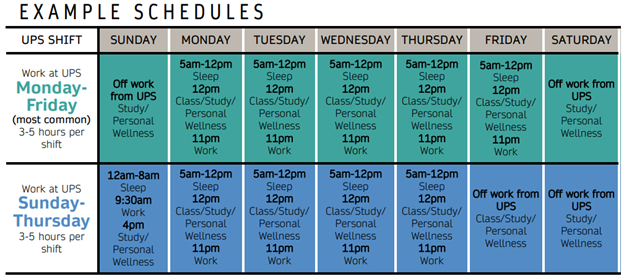
UPS does not adjust work schedules to accommodate academic responsibilities, including mid-terms or finals. Metropolitan College is an education benefit provided to eligible employees, and participation requires that students fulfill the responsibilities of their UPS position in order to maintain eligibility.
Just as faculty and staff are expected to manage their professional and personal commitments, students in the program are expected to plan ahead and manage their time responsibly. This includes preparing for exams, completing assignments, and balancing rest with work and study.
As faculty and staff, you can support Metropolitan College students by:
Encouraging early preparation for exams and assignments.
Sharing study strategies that work well for third-shift workers.
Promoting campus resources such as tutoring, academic coaching, and online materials that offer flexibility.
Your guidance and understanding can make a meaningful difference in helping these students succeed academically while meeting their work obligations.
Yes! Every student is assigned a MC Student Success Counselor by the first letter of the student's last name.
To identify a student’s assigned Metropolitan College Student Success Counselor (SSC), please refer to the Get Connected section. SSCs are equipped to connect students with the appropriate resources—whether on campus or at UPS—to help remove barriers and support their academic and professional success.
You may also encourage students to access their customized MC student portal by logging into their MyMC page using their date of birth and UPS employee ID (GEMS ID). Through the portal, students can view their assigned SSC and initiate contact for personalized support.
MC students are notified in advance of office closures so they can access support, remove barriers, and get their questions answered. During any closure, students should first review their MyMC Page and the FAQs available there for guidance and next steps.
If a student seeks assistance during a closure, faculty and staff can direct them to their assigned Student Success Counselor, whose contact information is listed on the student’s MyMC Page. While counselors are unavailable during closures, any messages received will be prioritized once offices reopen. Students are also encouraged to review their MyMC Page and FAQs for immediate information and guidance.
Thank you to faculty and staff for helping keep students informed and connected during closure periods.
It’s not uncommon for Metropolitan College students to experience fatigue due to the demands of third-shift employment. While this can impact their academic and extracurricular performance, it’s important to reinforce that participation in MC is a benefit, students must meet both their employment and academic responsibilities to remain eligible.
Here’s how you can respond constructively:
Acknowledge the Challenge
Recognize the difficulty of balancing overnight work with daytime academics. A simple acknowledgment can go a long way in building trust and encouraging open communication.Encourage Personal Accountability
Remind the student that, like all members of the university community, they are expected to manage their commitments responsibly. Time management and proactive planning are essential skills for success in this program.Refer to Support Resources
Encourage the student to connect with their MC Student Success Counselor (SSC), who can help them explore strategies for managing fatigue, accessing academic support, and navigating available resources. They can find their SSC via the Get Connected section or by logging into their MyMC portal using their date of birth and GEMS ID.Share Flexible Academic Supports
Offer guidance on study strategies that accommodate third-shift schedules, such as:Recorded lectures or asynchronous materials
Online tutoring or writing support
Peer study groups that meet during non-traditional hours
Maintain Expectations
While empathy is key, it’s also important to maintain academic standards. Encourage the student to take ownership of their success and seek help early when challenges arise.
Yes, faculty and staff are encouraged to reach out with questions, concerns, or feedback about the Metropolitan College program.
For general inquiries or to be connected with the appropriate staff member, please refer to the Get Connected section of the Metropolitan College website. This section provides contact information and guidance for connecting with program staff, including Student Success Counselors (SSCs). and administrative personnel.
If you have more specific questions, feedback, or would like to discuss aspects of the Metropolitan College program in greater detail, you're welcome to contact the MC Director or Executive Director. They are available to provide clarity, address concerns, and engage in meaningful dialogue to support both faculty/staff and student success.
While the goal is to maintain a fairly consistent schedule, flexibility is sometimes necessary to meet operational demand.
Metropolitan College students, like all UPS employees, may occasionally experience longer or adjusted hours, days, and shifts due to factors such as:
Seasonal volume increases (e.g., holidays)
Natural disasters or global emergencies
Critical shipping needs, such as during the pandemic when MC students played a vital role in distributing vaccines and medical supplies
During peak season—from late November through January—both the number of workdays and hours will increase to accommodate heightened shipping demand.
Students experiencing academic difficulty may benefit from campus tutoring, academic coaching, and a conversation with their Student Success Counselor. Encouraging early outreach can help prevent barriers from escalating.
Metro College recognizes that third-shift work and coursework can be challenging, and the program may not be the best fit for every student at every point in their academic journey.
If a student expresses concern about their academic performance, workload, or overall well-being, they should be encouraged to connect with their Student Success Counselor. All MC Students have access to the same resources that other students have. Counselors can listen to concerns, provide resources, offer tailored recommendations, and help students explore options that support both their academic and personal success. Faculty and staff are also encouraged to reach out directly to counselors with questions.
University of Louisville offers housing options and resources that Metro College students can explore during break periods.
While Metro College does not provide housing directly all students can explore housing options through Louisville Metro Government. Residential housing is an option for University of Louisville students who are encouraged to explore the Metro College Themed Community, which offers a supportive living environment designed specifically for first-year MC participants.
For summer housing, students must apply prior to the start of the summer term.
If students have additional questions or need help navigating housing options, they may contact Metro College’s Student Success Counselor housing liaison, Haley Zoeller at haley.zoeller@louisville.edu, or reach out directly to University Housing at housing@louisville.edu or 502-852-6636. Early communication is encouraged to ensure availability and support planning around break periods.
JCTC can also access resources and guidance for housing options through The HUB @ Jefferson.
Course withdrawal can impact a student’s tuition benefits, financial aid, and academic progress. Before withdrawing, students should contact their Student Success Counselor to review potential consequences, timelines, and next steps.
A counselor can review the student’s current tuition status, help calculate any potential amount the student may owe, and connect them with financial resources such as advising through our High 5 Program.
Eligible MC students also receive fee payment assistance and milestone bonuses that can supplement financially- view all benefits here.
Counselors can also provide guidance on how to use UPS earnings to help manage costs, support a necessary withdrawal, and prevent future stop-outs caused by unpaid balances or financial holds that may block future registration. Early communication allows the student to make an informed decision and avoid unintended financial or academic barriers.
Withdrawing from a course can have financial implications for Metro College students depending on timing and institutional refund policies.
Withdrawing from a course is sometimes the best academic option, and we understand this is not an easy decision for students. It can help protect a student’s GPA if they are unlikely to successfully complete the course. However, for Metro College students, withdrawals can have financial implications because MC only covers eligible grades (A, B, C, C-, P, S). If a student withdraws after the 100% add/drop deadline, the cost of that specific course will not be covered by Metro College. These deadlines can be found on JCTC’s academic calendar: https://jefferson.kctcs.edu/education-training/academic-calendar/index.aspx and UofL’s academic calendar: https://student.louisville.edu/registrar/registration/calendars. Ultimately, if a student drops a course past the deadline, they may be responsible for some or all of the course cost depending on the institution’s refund schedule.
We strongly recommend that students contact their assigned Student Success Counselor through their MyMC page to discuss potential financial impacts and payment options when or after withdrawing. If a student receives an ineligible grade (below a C or a W), they will also be responsible for the cost of the course. Both withdrawals and ineligible grades are outlined and reviewed when students sign their MC agreement each semester. If a student receives an ineligible grade, it is important that they work with their institution to set up payment promptly to avoid registration holds, past-due balances, or additional costs. Again, students should reach out to their Student Success Counselor via their MyMC page with questions.
Students can locate their assigned Student Success Counselor and scheduling options on their MyMC Page. Advisors can direct students there for the most accurate appointment information and reminders. Students can also contact our offices directly via phone.
Students should be encouraged to schedule early each semester to avoid delays in benefits and ensure their agreement is completed on time. The MyMC Page remains the best hub for counselor contact information, scheduling, and availability.
Students can enroll in morning courses; however, early classes may conflict with healthy sleep patterns for third-shift workers. If fatigue is impacting their performance, encourage students to explore alternative class times and connect with their Student Success Counselor to discuss a sustainable plan.
During the first semester, students often experience the greatest fatigue as they adapt to overnight employment, which can impact alertness, academic performance, and overall well-being. If a student reports feeling tired, overwhelmed, or unable to maintain a healthy sleep schedule, encourage them to explore later class times and connect with their Student Success Counselor. Counselors can help students evaluate a sustainable schedule and determine the best timing for transitioning into a full-time course load once they have successfully adjusted to third-shift work.
Encourage students to view more information on Mental Wellness Resources and Sleep tips here.
It’s common for third-shift students to need help balancing work and academics. While continuing Metro College students are encouraged to enroll in 12–15 credit hours during fall and spring, the ideal course load depends on their major, readiness, and sleep schedule. If a student seems overwhelmed, encourage them to consider a lighter full-time load and connect with their Student Success Counselor for individualized support.
Based on more than 25 years of program experience, Metro College has found that new third-shift students are most successful when they take 10 credit hours or fewer during their first semester. This reduced course load supports a student’s adjustment not just academically, but in developing a healthy sleep routine, managing work demands, and adapting to third-shift life.
After a student successfully completes their first semester and has adjusted to their work and sleep schedule, Metro College recommends transitioning to a full-time course load, along with summer coursework, to stay on track for timely degree completion.
More information on course-load planning and recommended degree timelines can be found in the MC Advising Guide.
JCTC and UofL advisors can locate and verify active Metro College students through standardized PeopleSoft codes and CardSmart tags that are maintained throughout the term.
JCTC Advisors can identify an MC student by using the following student group codes in PeopleSoft for each semester:
- Spring: MCSP
- Fall: MCFA
Each semester, we import current actively participating MC students into PeopleSoft on the following dates:
For Spring: Students are imported into PeopleSoft on November 1 and December 1 for the upcoming spring term, and on February 1, April 1, and May 1 for the current spring term.
For Fall: Students are imported on April 1, June 1, and July 1 for the upcoming fall term, and on September 1 and November 1 for the current fall term.
UofL Advisors can easily identify active MC students in CardSmart under the “Tags” section (e.g., Metro-College-[Semester Number]).
Additional student support information, including the student’s assigned Metro College counselor, can be found in CardSmart under “Your Success Team.” The counselor will be listed with last name, first name, and the title MetroCollege Counselor.
UofL Advisors can also identify an MC student using the student group code: METR in PeopleSoft.
The initial setup of these student groups occurs on:
- January 2 for Fall
- June 1 for Spring
- October 1 for Summer
After the initial setup, this is updated weekly.
To verify whether a student has priority registration access, this will be tagged in PeopleSoft as: MCPR.
This is tagged on a students account if they are active and currently in the program. The initial setup of these tags occur on:
- March 15 for Summer and Fall registration
- October 15 for Spring registration
- October 1 for Summer
Supporting an MC student whose course schedule is challenging due to course availability aligned with the realities of third-shift work requires a combination of creative scheduling, proactive planning, and collaborative problem solving.
Here are several approaches you can take:
1. Explore online course options for added flexibility.
If the student is comfortable with online learning, look for opportunities to enroll them in online or hybrid courses to reduce the strain of attending in-person classes early in the morning.
2. Review the four-year plan together and anticipate barriers.
If scheduling constraints are common in this major, walk through the program’s four-year plan, inclusive of the summer term, with the student. Identify semesters where course sequencing, limited offerings, or block scheduling may pose challenges. From there, brainstorm strategies so the student can maximize MC benefits for as long as possible—such as taking summer courses, shifting electives earlier, or planning ahead for semesters where a reduced course load may be necessary. You can also discuss additional financial resources that may support their degree progress if they eventually need to transition to non-MC-funded semesters.
3. Partner with their Student Success Counselor to find creative solutions.
Encourage outreach to the student’s assigned MC Student Success Counselor to jointly explore options. For example, career pathways in areas like healthcare, education, or IT are specifically designed to support degree completion for students managing complex schedules, while also providing enhanced tuition assistance. These pathways may align well with the student’s goals and offer added stability.
4. Advocate within your department for increased flexibility.
If you consistently see MC students—or any students—struggling with required course times or limited availability, bring these concerns to your department leadership. Advocating for more flexible scheduling models, such as additional online sections, evening classes, or rotations of block-scheduled courses, can better support working students and improve retention across the program.
Metro College advising occurs on a set schedule that differs from the standard university timeline.
MC students operate on a different timeline than typical students in order to optimize their course schedules and secure tuition benefits. Students receive regular communications before and during their required advising month for upcoming semesters. This requirement is also reviewed and acknowledged in the agreement they sign each semester.
- Summer & Fall: February
- Spring: October
Please view our advisor update video each semester for important dates related to advising and enrollment.
MC students are expected to register within specific early timeframes each term to secure optimal course schedules.
MC students register on a different schedule than typical students in order to better optimize their course schedules for third-shift work. Students are regularly notified by their Student Success Counselor of their expected enrollment timelines for each institution.
JCTC: For Summer and Fall, MC students are expected to register within the first 45 days of registration opening, beginning February 1. For Spring, students are expected to register within the first 45 days of registration opening, beginning October 1.
UofL: MC students are expected to register within the first 5 days of priority registration opening for Fall, Spring, and Summer. For Summer and Fall, priority registration typically opens at the end of March, and for Spring, it typically opens at the end of October. All active MC students at UofL have access to Priority Registration. Advisors and supporting staff are encouraged to review our Early Advising video each semester for specific dates and additional guidance.
Semester agreements outline advising and registration expectations, and counselors support students through enrollment.
Each semester, students sign agreements to secure their tuition benefits, which includes reviewing and acknowledging early advising and registration dates. Students can also find these dates on their MyMC Page. Student Success Counselors proactively reach out to students prior to these dates and continue outreach until the student is enrolled.